 CopyTrans Studio

Have you ever deleted a photo from your iPhone and immediately regretted it?
A few weeks ago, I was freeing up space on my phone and happily tapped “delete” on dozens of screenshots and duplicates. Everything was fine until I realized that one of those photos wasn’t just another useless photo, but an important one. For a moment, I thought it was gone forever.
If you’ve experienced the same panic, then we’re in the same boat. So, where are deleted photos on iPhone? Deleted photos on the iPhone don’t just vanish, but it’s not always clear how Apple manages them. That’s why I want to tell you what really happens when you delete a photo: where it goes, how long it stays there, and what else you can do if the 30-day period has already expired.
Where to find deleted photos on iPhone?
Here’s what I didn’t understand at first: deleting a photo on my iPhone doesn’t mean it’s gone forever. In fact, it goes into a special folder called “Recently Deleted”. This is a small insurance policy from Apple in case you accidentally delete an important photo.
Here’s how it works:
- Storage period: photos are stored for 30 days, after which they disappear forever.
- Location: open the Photos app → Albums → Recently Deleted.
- Reality: even if you clicked “Delete”, the photo hasn’t actually disappeared — it’s just waiting for you to change your mind.
What happens after 30 days?
After 30 days, the security system stops working. Deleted photos are automatically erased, and there is no “Cancel” button. A few more details:
- iCloud photo syncing: if you have iCloud enabled, deleting a photo on one device moves it to the “Recently Deleted” folder on all your devices. So be careful — this applies to more than just your iPhone.
- Permanent deletion: after 30 days, the photo disappears from both your iPhone and iCloud. At this time, Apple does not offer a built-in way to recover it.
Avoid losing photos
with CopyTrans Studio
Here’s the truth: once photos disappear from your iPhone and iCloud after 30 days, they’re gone forever. Apple doesn’t give us a way to get them back. That’s why I changed my approach – instead of worrying about recovering deleted photos, I focused on never losing them in the first place.
With CopyTrans Studio you can back up my iPhone photos in just a few clicks — no cables, no iTunes headaches, no fear of losing quality or organization.
Why it matters:
- Permanent backup on your PC — even if the photos disappear from my iPhone or iCloud, they’ll still be safe on my computer.
- No compression or loss of quality — my photos look exactly the same as they do on my iPhone, down to the last pixel.
- More control over my media files — I can organize, move, and store my photos exactly where I want them.
- Peace of mind — instead of worrying about the 30-day countdown, I know my memories are already safe.
- Download and install CopyTrans Studio. Download CopyTrans Studio
- Click on the CopyTrans Studio icon. Open the program.
- Choose your iPhone, then Photo Library
- Now choose a Backup option. This will save all your photos and videos on you PC in a few clicks

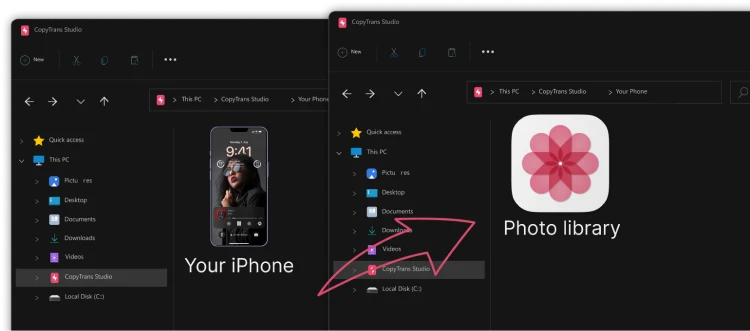

One more interesting feature of CopyTrans Studio an automatic backup option.
Common mistakes
Over time, I’ve noticed that most of us fall into the same traps when it comes to managing photos on our iPhones. Here are a few mistakes that cost people their memories:
The idea that “deleted on iPhone” = safe in iCloud.
This one gets a lot of people. The truth is, if you have iCloud Photos turned on, deleting a photo on your iPhone deletes it everywhere: in iCloud, on your iPad, on your Mac. It’s syncing, not backing up.Forgetting to check the “Recently Deleted” folder.
I can’t count how many times I’ve seen people panic because they couldn’t find a photo that was sitting in the “Recently Deleted” folder the whole time. Always check this folder first before assuming the worst.Backing up before deleting large albums.
It’s tempting to “clear space” by deleting hundreds of photos at once. But without a proper backup, it’s a one-way ticket. Trust me, it’s not worth the risk.
Where are recently deleted photos on iPhone
FAQ
If I delete a photo from my iPhone, will it remain on my Mac?
It depends on the situation. If you use iCloud Photos, the deletion will sync across all your devices, so the photo will disappear everywhere. But if you previously imported photos manually to your Mac, they will remain there safely.
Do deleted photos take up storage space while they are in the Recently Deleted folder?
Yes! Until they are permanently deleted, they still take up space on your iPhone and in iCloud. That’s why deleting a large album doesn’t free up space instantly.
Can someone else recover my deleted photos from my iPhone?
If they have access to your Apple ID and password, then yes. They can check the Recently Deleted folder or even recover photos from your iCloud backup. Another reason to keep your Apple ID as secure as possible.
What happens to deleted photos if my iPhone is offline?
If you delete photos while offline, they will be deleted from your device, but the changes will not be synced to iCloud until you go back online. This means that sometimes you can still find them in iCloud if you act quickly.
Where are deleted photos
Final thoughs
Deleted photos on an iPhone don’t disappear instantly, but the 30-day storage period is shorter than most of us think. I’ve been to this situation when memories disappeared. A more sensible approach is not to hope for the recovery of lost photos, but to make sure they are not at risk in the first place. Back them up on your PC, organize them outside of iCloud, or use CopyTrans Studio to keep every photo safe and accessible.
After all, when a photo is truly gone, no “undo” button can bring it back. Taking control now not only relieves stress, but also keeps important moments exactly where you want them.